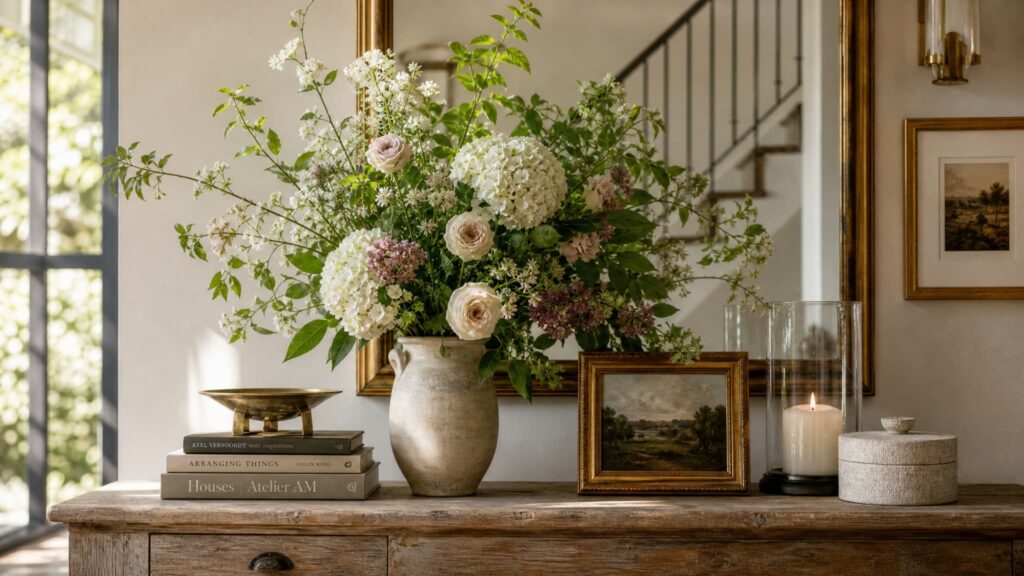
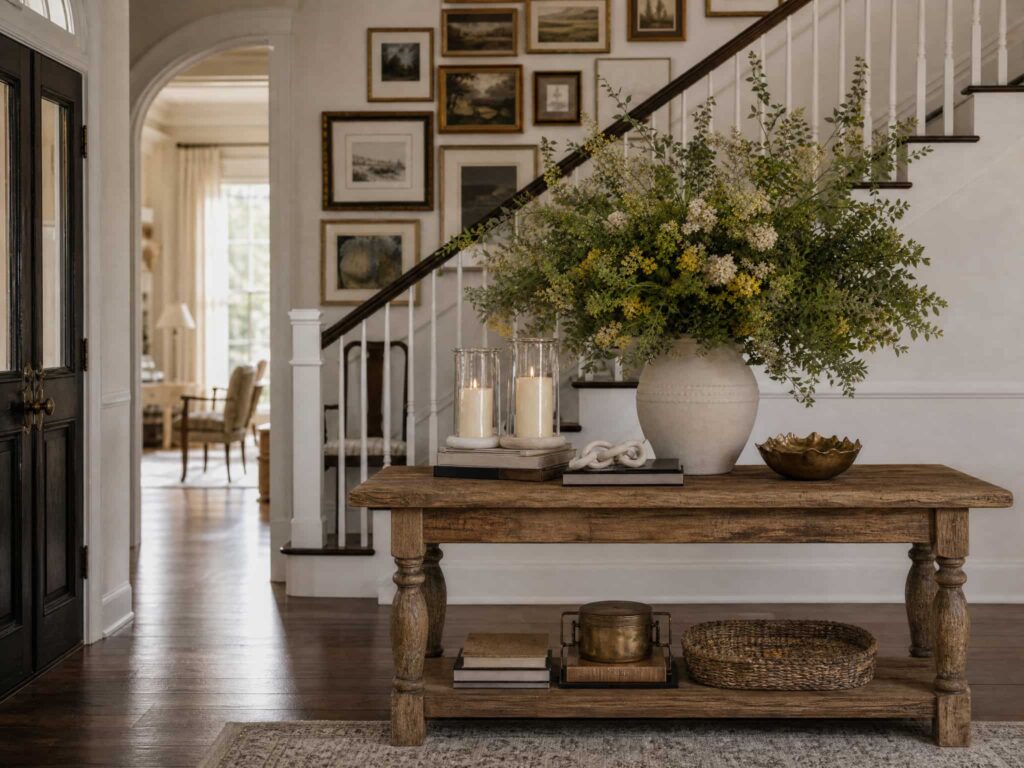
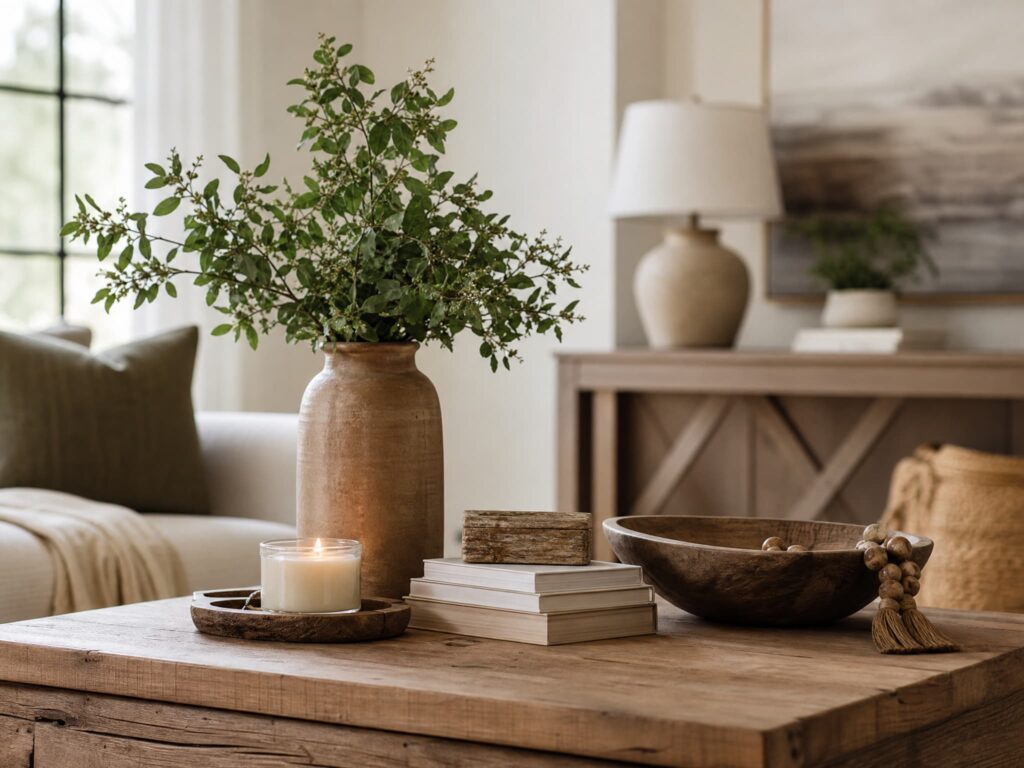
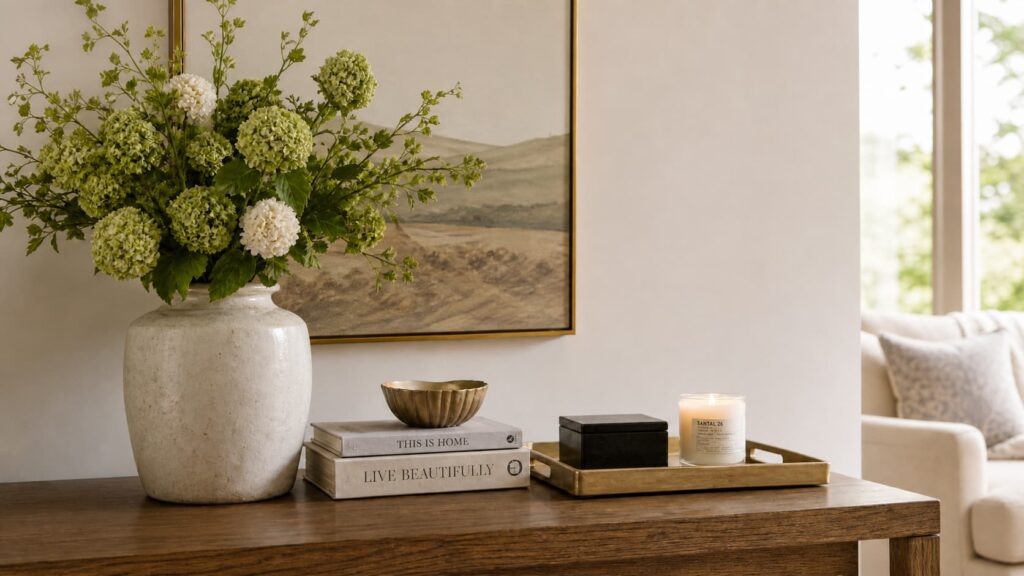
Most people add flowers and floral arrangements, often, as the final touch in their room decor. This is the reverse of how you should approach styling. Many stylists and designers use greenery or florals as the starting point of any room decor. These designers may not all literally say “step one: florals”, but if you look at their console table styling, entryway table decor or coffee table decor, botanicals are almost always the first or main move. Something living (or at least organic) is the *anchor* of their room decor and vignettes. That does a few things:
Sets the height and shape of the composition very early.
In this post, we look at 5 designers; Studio McGee, Amber Lewis, Joanna Gaines, Charlotte Moss and Bunny Williams to help you discover the best way to consider and establish your own room decor styling to make it seamless and effortless. It will help you to save time to enjoy your spaces with family, friends or your own pause time.
If many designers use flowers, florals or botanicals as their anchor and starting point, why don’t we do it?
Why Most People Skip Florals in Room Decor
Flowers die: The design feels temporary and high-maintenance.
Cost: Buying fresh flowers continuously is expensive compared to permanent decor.
Easy to get proportions wrong: Arrangements are either too large or small and feel ‘hit and miss’.
Style mismatches: Use the wrong vessel or flowers and your room decor feels disconnected from the room.
Overcrowding: Pack too many decor items around the flowers and the result is no focal point.
Why You Shouldn’t Skip Past
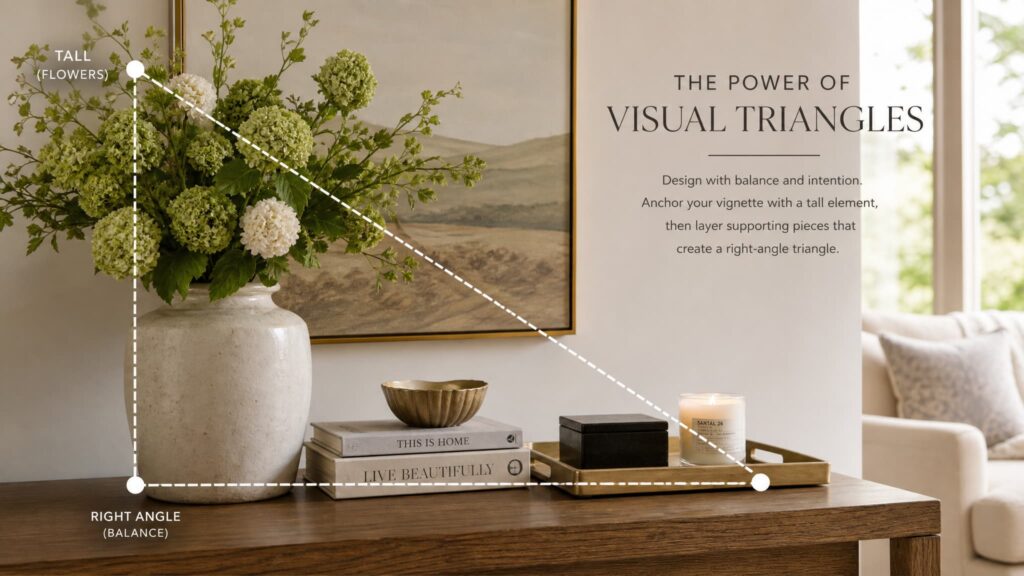
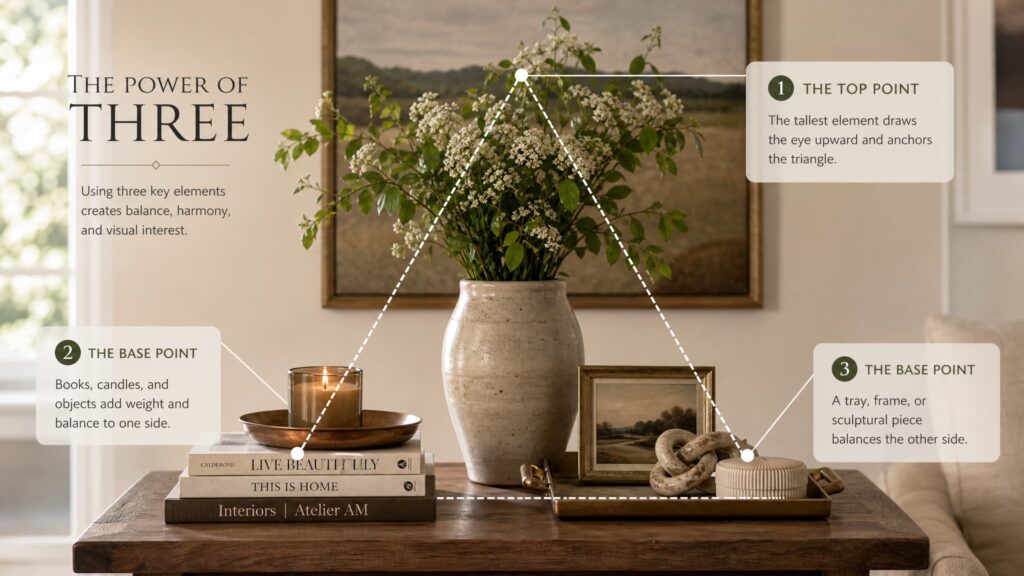
Here’s why you shouldn’t skip flowers; they become the top of the triangle for your vignette and room decor. Establish the height first. Its far easier to complete the triangle; whether you use an odd number of elements, or simply fill in the space within the triangle. The other two sides of the triangle are easier to control because the one element that can change everything, the height of your florals, is now set. And that’s why adding flowers at the last minute can go from ‘just add flowers’ to a visual disaster. How often have your flowers been removed, or you feel like you have to start again?
Triangles and Three Point Thinking
Once you learn about visual triangles in styling, its hard to unlearn. You will spot them everywhere. Triangles are often used because they lead to excellent results. The idea is to position objects in such a way that their outline forms a triangle. This system works for most triangles. The eye reads the style and shape as balanced.
When flowers go in last, you’ve usually filled the space — books stacked, a tray placed, a candle set down. There’s nowhere left for the vase to sit but a leftover gap, so it ends up too small, too tall, or crammed into a corner that doesn’t quite work.
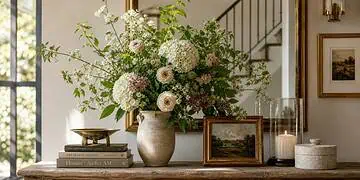
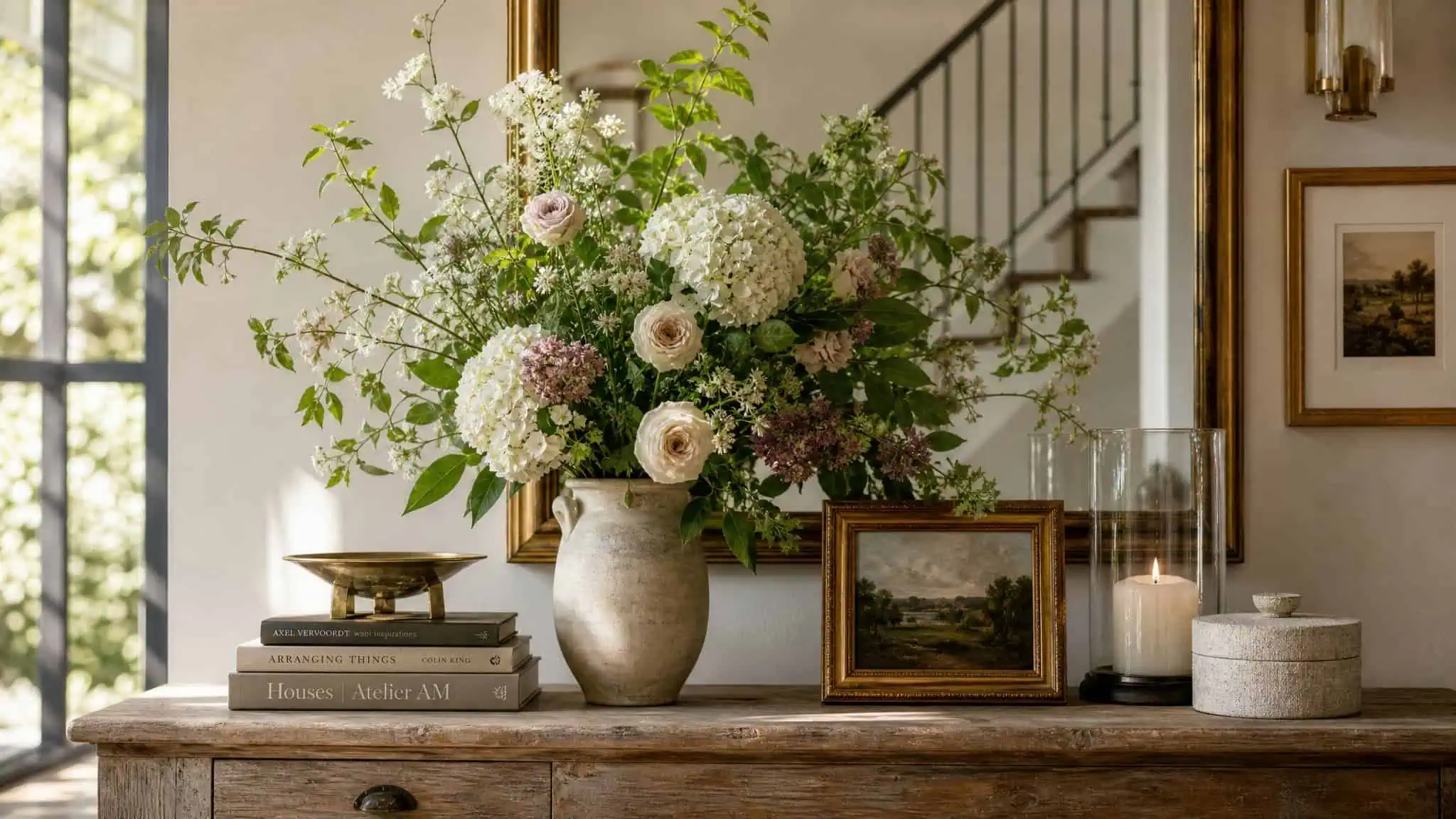
Start with the flowers instead, and the opposite happens. The vase sets the height and the shape first. Your flowers, being the tallest, naturally become that top point.
Flowers, stems or any kind of organic element are often added after you’ve completed your entry staircase table styling or coffee table decor because they are purchased closer to the occasion when you expect guests or gathering. And we’ve already discussed why. Their temporary life makes planning difficult.
We think you should enjoy flowers in your room decor for a few days before guests arrive. Enjoy their delicious scent along with other mantel decor or tray styling. Enjoy all of it. You deserve it; and so does your family. You will have time for the flowers to bloom and settle in; looking more natural and organic.
How to Embrace Real and Fake Flowers in Your Room Decor
The elephant in the room are fake flowers (‘faux’ or ‘artificial’ if you want to avoid the word fake). And from influencers, designers, big box stores and small boutiques, the money right now is on fake. It took decades, but they look realistic, last longer, cost about the same as the real deal; its a one off purchase and are always there, at-the-ready, to use. Most will ignore microplastics in the air or the damage to the environment.
If you prefer ‘real’ and don’t mind a little ‘fake’, this makes it easier to embrace the floral-first-rule in your room decor styling.
Use these tips as short cuts for the days you don’t have time, to buy or spend money on flowers, but still want that ‘wow’ factor in your room decor.
1. For Fast and Best Results
Go minimal: Use a single, striking stem instead of a full bouquet.
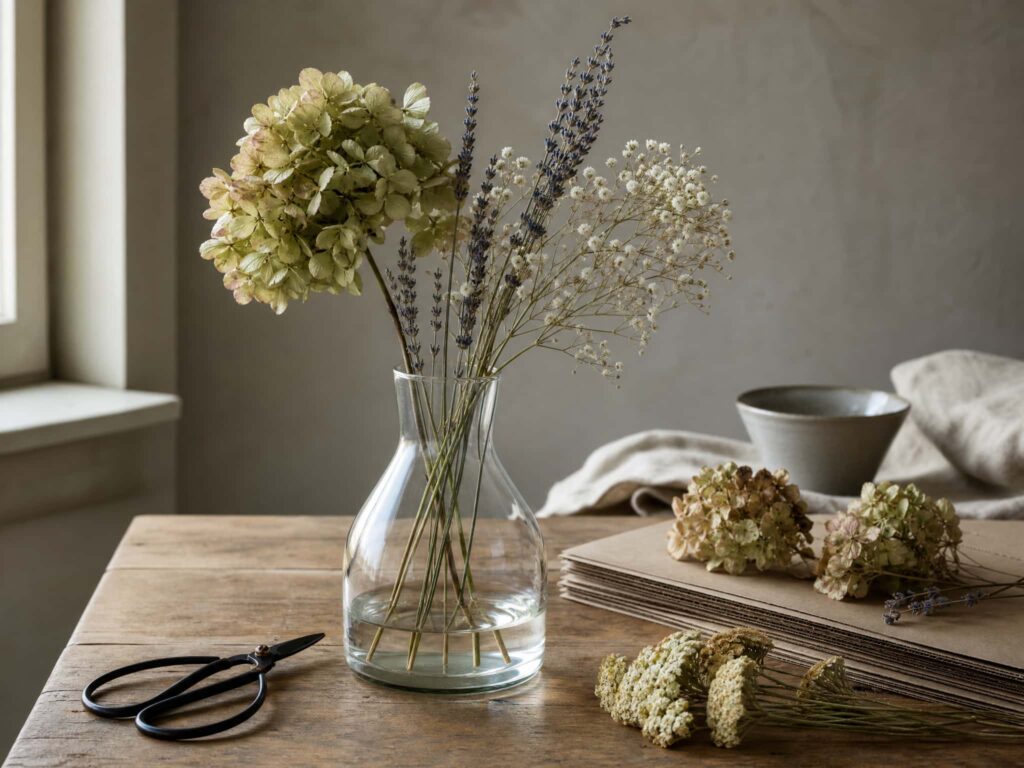
Embrace dried: Select varieties like hydrangeas, eucalyptus, or baby’s breath that look beautiful as they dry. (We mention a floral drying technique below; simple, easy – set and forget – to create your own Dry Supply of Flowers.
Mix high-quality faux: Blend hyper-realistic fake greenery with a few real stems to fool the eye cheaply. [1]
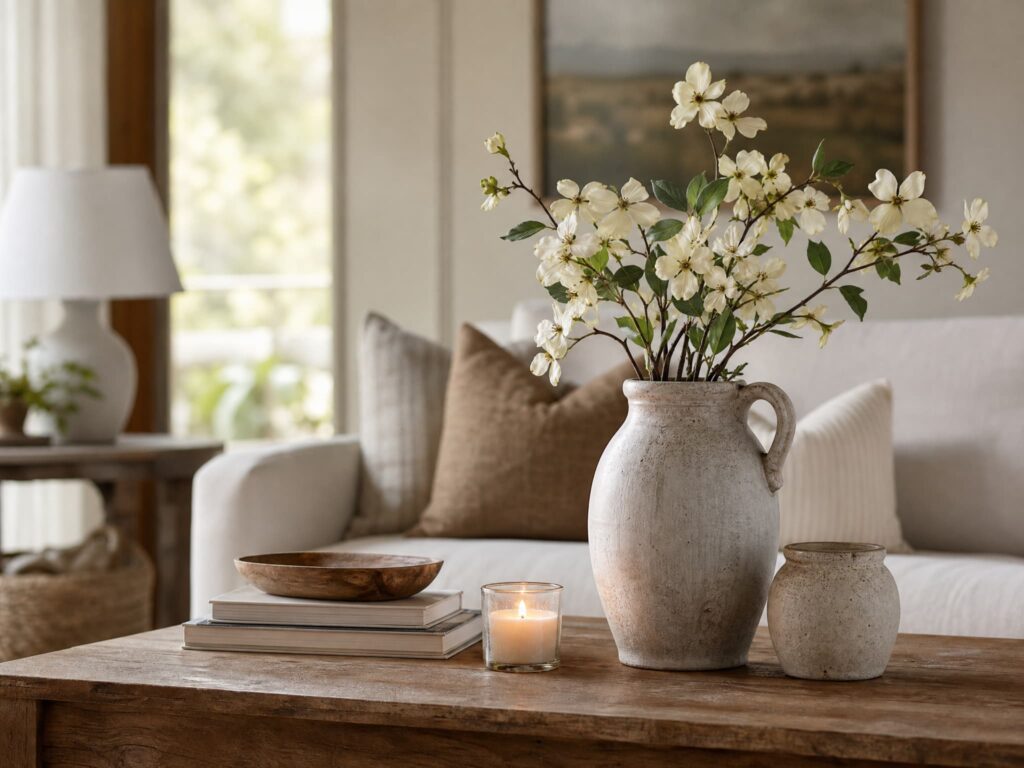
Use the rule of thirds: Your floral arrangement should take up about 1/3 to 2/3 of the vertical space. This rule works well with room decor on coffee tables, entryway table decor or side tables to create a sense of height and grandeur.
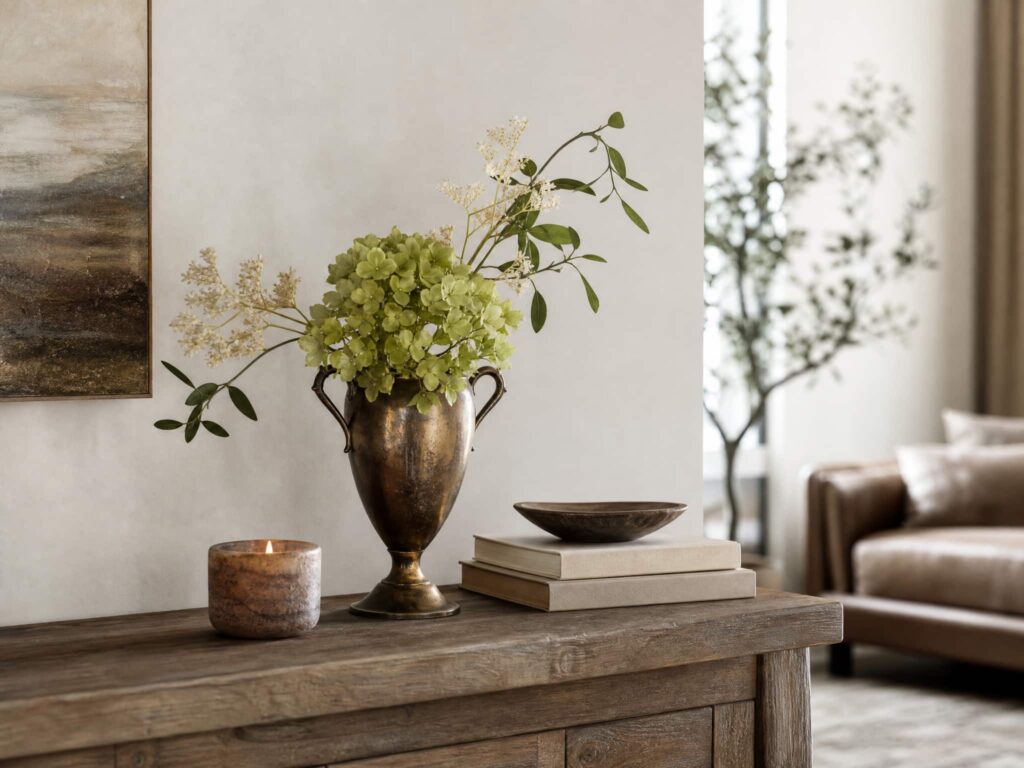
Vary heights: Pair your flowers with a taller object (like a candle) and a shorter object (like a small dish). This depends on your floral selection and available space and works well; even with a single stem.
Anchor: Place your vase or container on a stack of books or a tray to ground it or for extra height. [1, 2, 3]
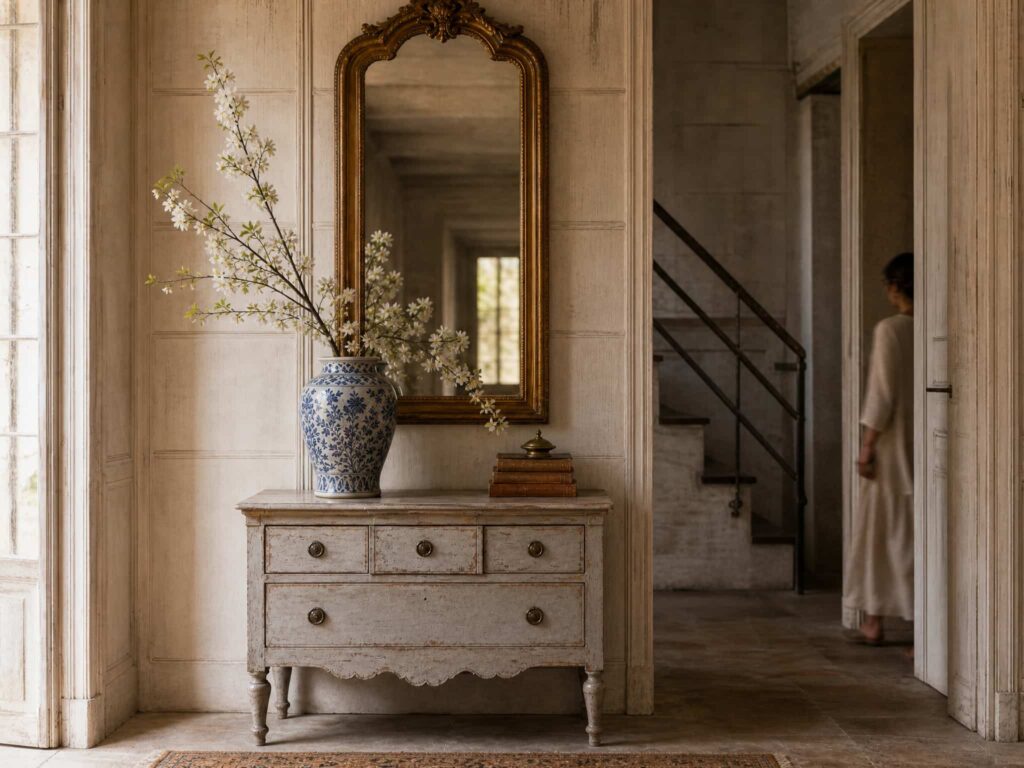
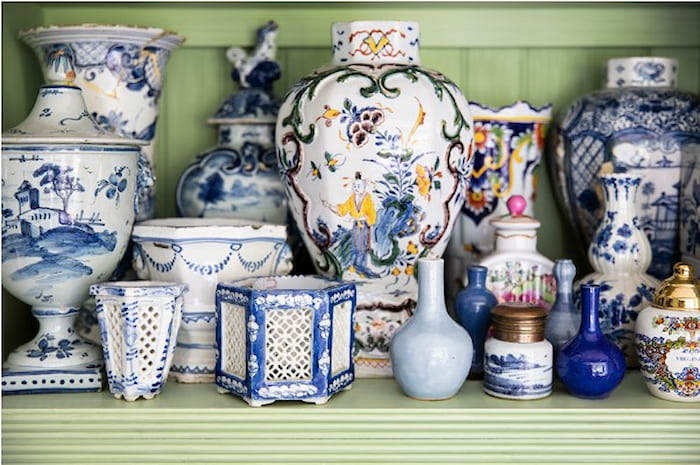
Vessel textures and variety: Swap standard glass for unique items like ceramic jugs, vintage trophies, or antique urns.
Flower with room colors: Pull one minor color from your rug or artwork and match the flower petals to it.
Stay Consistent: Pair a casual wildflower with a relaxed wicker basket, not a formal crystal vase. [1, 2]
4. Avoid Overcrowding
Textural contrast: Pair soft, rounded petals with architectural elements like proteas or eucalyptus
Stick to odd numbers: Limit your entire vignette to three or five total elements.
Grid base: Place chicken wire or a metal frog inside your vase to lock stems in place and prevent flat-looking bouquets or needing additional flowers or fillers.
Layering order: Add large statement blooms first, secondary flowers next, and finish with fine filler stems.
Leave negative space: Allow empty space around the flowers so the eye has a place to rest.
Enforce a strict theme: If an item does not directly support the mood of the flowers, remove it.
“The reasons to start with flowers first is that they –
Set the height and shape of your vignette, soften hard materials like wood, marble, metal or glass in your room and bring in color and movement with their organic natural look. Once you have your foundation in place everything else becomes easy.”
Now lets start styling your room decor.
1. Studio McGee (Shea McGee)
Style: Fresh, light, American “new traditional” room decor.
How Studio McGee uses the florals first rule.
Look at almost any Studio McGee console table styling or coffee table decor: a large vase of branches or greenery lands first, then books, a bowl and a candle gather around it. The botanicals set the scale and mood – everything else is supporting cast. In countless reveals, Shea starts consoles and coffee tables with a large vase of branches or greenery, then builds everything else around it.
In Studio McGee’s – “Our Favorite Moments Styling With Branches” (blog), you can see consoles with:
Then a stack of books, a small bowl, and maybe a candle added as supporting pieces.
The vignette clearly “belongs” to the branches; everything else is secondary. Watch the reel to see how Shea does it.
2. Amber Lewis (Amber Interiors)
Style: Laid‑back California, earthy and layered room decor.
How Amber uses florals first rule.
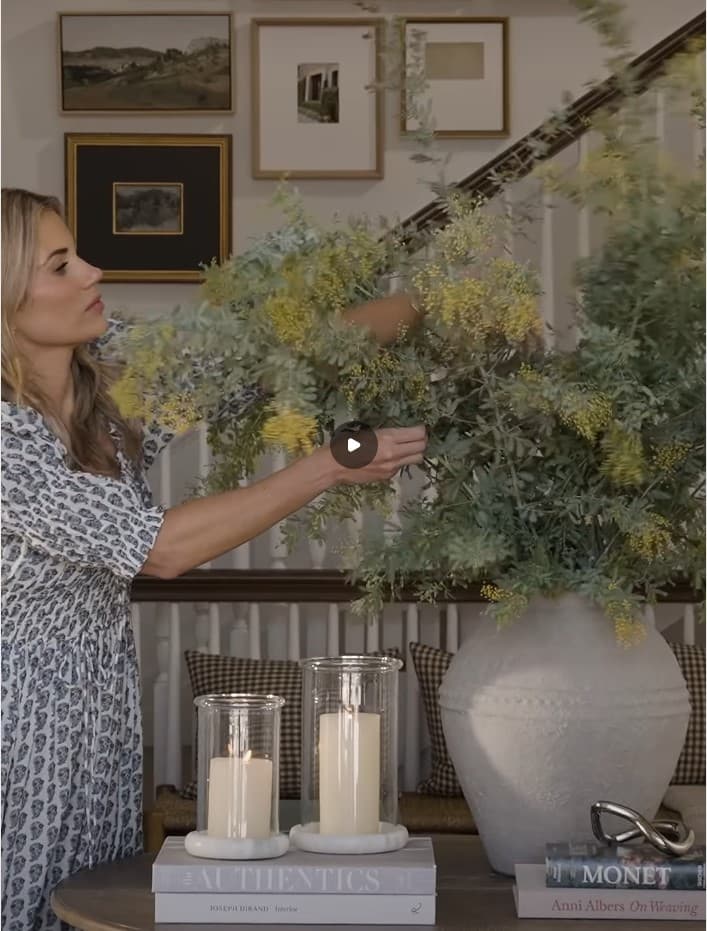
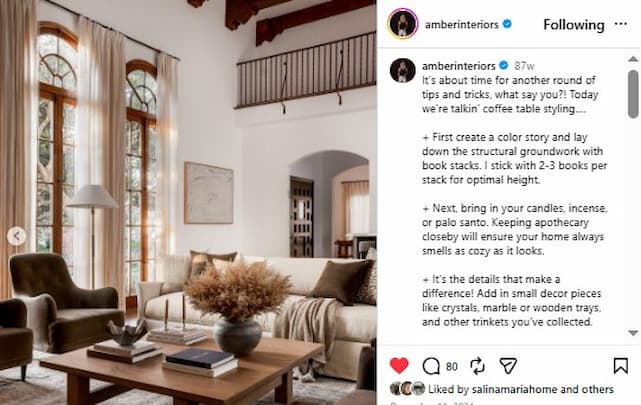
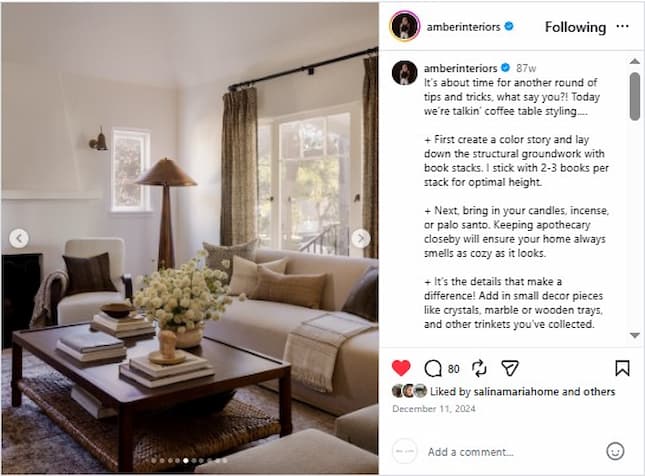
Amber’s styling nearly always starts with a big, loose bunch of branches or olive stems in a chunky vessel. On coffee tables and sideboards, that organic shape is clearly the foundation; books, ceramics and trays are then added to balance the foliage. Visually, the massive, architectural foliage is undeniably the anchor of the room. Her signature “laid-back, California aesthetic” relies heavily on oversized, loose olive branches, eucalyptus, or wild stems sitting in rustic, chunky vintage stoneware. The scale of the greenery is what dictates the layout of everything else.
While Amber Lewis technically places her book stacks first during her physical styling tutorials, make no mistake: the foliage is the true foundation of the design. The entire table layout is planned around the scale of the branches. If you mentally remove that massive, organic statement piece, the composition completely collapses. The books lay the groundwork, but the branches dictate the blueprint.
Typical scene:
A large, empty quadrant of the table is intentionally left open while stacks of books and shallow dishes are placed at lower heights.
Then, a low, rustic pot with tall, loose branches is placed in that reserved space as the final crowning layer—perfectly filling the vacuum that was planned for it from the very start.
Foliage as the “Hero” Element
Asymmetry and Scale: Amber rarely uses manicured, tight floral arrangements. Instead, she uses sprawling, asymmetrical branches that reach high and wide. This immediately defines the vertical axis of the coffee table. [1, 2]
The Chunky Vessel: The weight of a vintage ceramic, stone, or iron pot grounds the entire table. Because the vase is massive, it acts as a fixed architectural point. [1]
Balancing the Elements
Creating Depth: Smaller items like beads, low bowls, or candles are tucked near the base of the chunky vessel to bridge the gap between the high branches and the flat surface of the table. [1, 2]
Grounding the Height: Because a loose bunch of branches is tall and airy, she places low, flat book stacks on the opposite side. This stops the table from looking top-heavy or cluttered. [1, 2]
Contrasting Textures: The wild, organic leaves directly contrast with the sharp geometric lines of her book stacks and the smooth surfaces of marble catchall trays. [1, 2]
3. Joanna Gaines (Magnolia)
Style: Modern farmhouse, warm and casual.
How Joanna uses florals first rule:
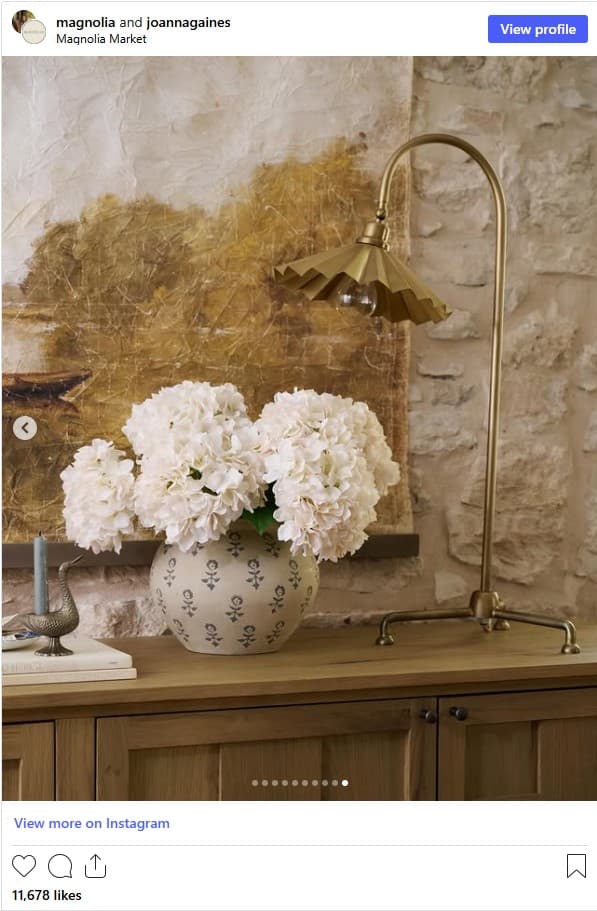
Mantel decor, console table styling and kitchen islands in Magnolia projects nearly always feature a vase of greenery or simple florals as the hero element. Joanna often talks about “bringing in something alive” to finish a space, but in photos you can see it often goes in first as the anchor of the vignette and styled decor. Lately, Joanna has been using more faux blooms instead of real blooms. They look real, and add color and structure to the space.
4. Charlotte Moss
Style: Classic, romantic, very layered.
How Charlotte uses florals first rule:
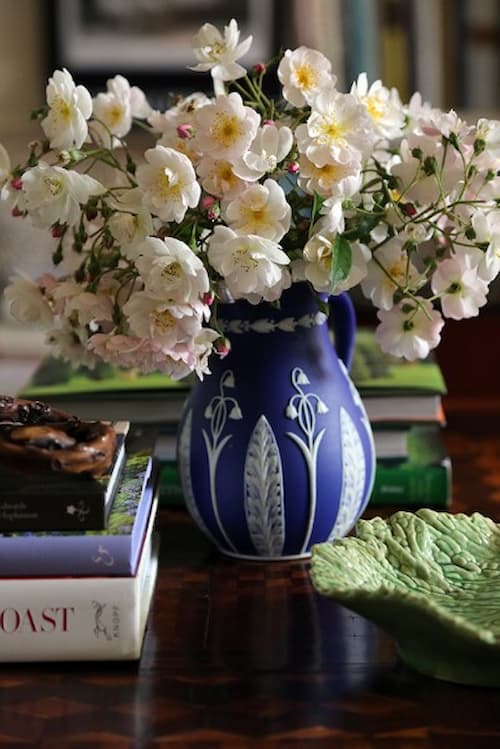
Charlotte is almost synonymous with flowers in room decor. Her side table styling, consoles and cocktail tables are built around full arrangements of garden cuts. The flowers dictate height, color and mood; lamps, books and objects are arranged around them, not the other way around.
Charlotte is famously flower-obsessed; arrangements are not an afterthought but the heart of her room decor styling. “Books and rules are good to guide you, but they should not dictate.”
Typical side table / console:
A full, abundant bouquet goes down first – often peonies, roses or garden cuttings.
Then she tucks in books, a small box, maybe a framed photo and a decorative object.
The florals dominate room decor vignettes in height, color and mood; the objects feel selected to echo and support the arrangement. Keeping a small selection of vases means you can cater to any supply of flowers or position from living room to landing.
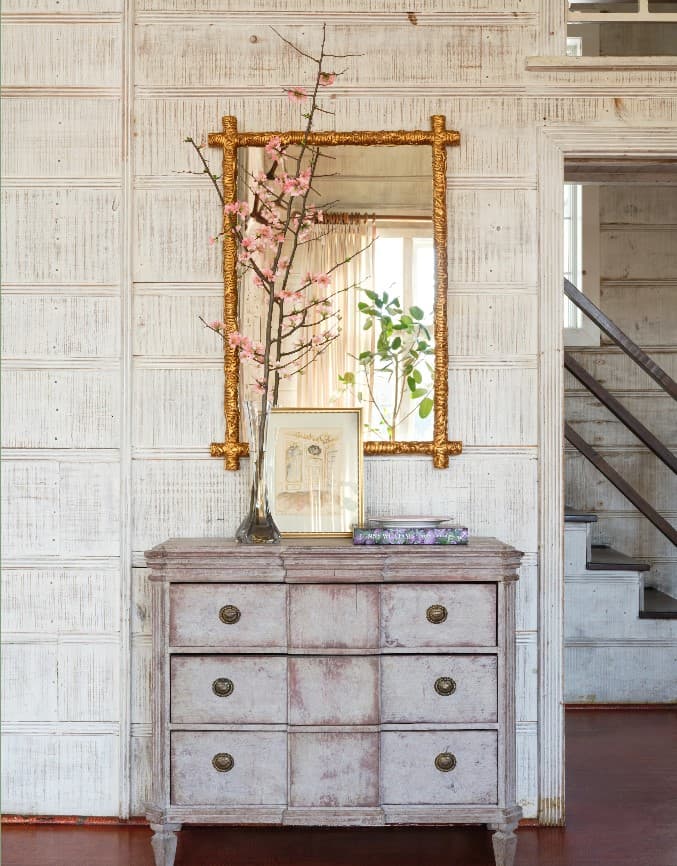
In Bunny’s room decor, there’s nearly always a bouquet, a potted plant or a bowl of garden clippings taking pride of place on a table or console. The botanicals often provide the tallest, softest element in the vignette, then books, boxes and trays are layered in to echo the colors and balance the scale.
We love this idea of florals first and find it a simple, never fail room decor styling tool that makes creating pause worthy vignettes and nooks come alive. Here is the water drying cut flower technique we talked about earlier. If you can save your flowers, and reuse them, why not?
Water Drying Cut Flowers for Room Decor Styling
If you have cut flowers from your garden or store bought florist flowers, you can dry them to reuse in your room decor. They may not be as sturdy as their artificial counterparts but using real dried flowers instead of faux alternatives adds authentic texture, organic beauty, and a sustainable touch to your room decor. The water-drying method is highly effective for a wide range of popular, sturdy blooms. [1, 2]
Real dried flowers last 12 to 36 months if you keep them out of direct sunlight, high humidity, reduce touching and dust accumulation. Use hairspray when they are dry, and store in a cardboard box, lined with paper, to keep their color and protect blooms.
Fake silk flowers last 5 to 10 years but collect deep dust that stains the fabric.
Fake plastic flowers last decades. [1, 2, 3, 4, 5]
Best Real Flowers for Water Drying
Hydrangeas dry perfectly this way, holding their large, spherical shape and fading into beautiful antique tones.
Baby’s Breath (Gypsophila) maintains its delicate, cloud-like structure without dropping its tiny white blossoms.
Statice keeps its incredibly vibrant purples, pinks, and yellows intact through the slow evaporation process.
Lavender retains its iconic fragrance and deep blue-purple color exceptionally well when dried slowly in shallow water.
Yarrow features flat, sturdy flower heads that do not droop or lose their dense structure as the water disappears.
Globe Thistle preserves its striking, architectural steel-blue spheres and stiff stems without structural warping. [1, 2, 3, 4, 5]
Steps for Water Drying
Trim stems at an angle before putting them in the vase.
Add shallow water—just 1 to 2 inches deep—so the flowers do not sit in too much moisture.
Let water evaporate naturally in a cool, dry spot out of direct sun until the blooms start to dry out. This can take 1 – 2 weeks.
Remove from the vase once the buds slightly wilt and the stems feel partly dry.
Cut the wet tips off the bottom of the stems to stop mold.
Lay flat on paper or cardboard to finish drying all the way through.
Read more on the blog, join our email list, follow us on Instagram, Pinterest and Facebook for more ideas or come see our products on Shopify or Amazon.